Enhancing Poultry Gut Health: The Roles of Prebiotics, Probiotics, and Postbiotics

Sonja Eksteen: Operational Nutritionist

With the global shift away from antibiotic growth promoters in poultry production, the focus has turned to natural alternatives that support gut health and overall performance. Among the most promising are prebiotics, probiotics, and postbiotics—each playing a distinct but complementary role in maintaining a healthy gastrointestinal tract (GIT) in poultry.

Prebiotics are non-digestible food ingredients, typically fibers or oligosaccharides, that selectively stimulate the growth and/or activity of beneficial microorganisms already present in the gut. In broiler nutrition, prebiotics play a crucial role in promoting gut health and overall performance.

The main purpose of prebiotics in Broiler Nutrition is enhancing gut microbiota balance.
Prebiotics encourage the proliferation of beneficial bacteria such as Lactobacillus and Bifidobacterium, which can outcompete pathogenic microbes like Salmonella and Clostridium.

Prebiotics indirectly improves nutrient absorption. A healthier gut environment leads to better digestion and absorption of nutrients, which supports growth and feed efficiency.

Prebiotics boosts immune function by supporting a balanced microbiome. It modulates the immune system, making broilers more resilient to infections and stress.

As part of antibiotic-free production strategies, prebiotics serve as natural alternatives to promote health and performance without relying on growth-promoting antibiotics.

The most common Prebiotics used in Poultry Feed are Fructo-oligosaccharides (FOS), Mannan-oligosaccharides (MOS), Inulin and Galacto-oligosaccharides (GOS)

Oligosaccharides (e.g., xylo-, fructo-, and galacto-oligosaccharides) are the most studied prebiotics in poultry. They are derived from non-starch polysaccharides (NSPs) and fermented primarily in the caeca. Fermentation produces short-chain fatty acids (SCFAs) like acetate, propionate, and butyrate, which serve as energy sources, lower gut pH and inhibit pathogenic bacteria.

Probiotics are live, non-pathogenic microorganisms that, when administered in adequate amounts, confer health benefits to the host. The main function in Poultry is to modulate gut microbiota by promoting beneficial bacteria (e.g., Lactobacillus, Bifidobacterium, Saccharomyces) and suppressing pathogens like Salmonella and E. coli. Probiotics enhance the gut barrier integrity by stimulating mucin production and tight junction proteins. Probiotics regulate immune responses, increasing anti-inflammatory cytokines (e.g., IL-10) and reducing pro-inflammatory markers (e.g., IL-6, IFN-γ). Probiotics improve nutrient absorption and feed efficiency, leading to better growth performance.

Probiotic spores are a specialized form of probiotics—specifically, they are dormant, highly resistant forms of certain bacteria (usually Bacillus species) that can survive harsh conditions like heat, acidity, and feed processing. Once ingested by broilers, these spores germinate in the gut and become active, exerting beneficial effects similar to conventional probiotics. Common Spore-Forming Probiotic Strains are Bacillus subtilis, Bacillus licheniformis, Bacillus coagulans and Bacillus amyloliquefaciens

Postbiotics are bioactive compounds produced during the fermentation process by probiotics. Unlike probiotics (which are live microorganisms), postbiotics are non-living microbial products or metabolites, such as enzymes, peptides, organic acids, cell wall fragments, and short-chain fatty acids, that still offer health benefits to the host.

The main purpose of postbiotics in broiler nutrition is to support gut health. Postbiotics help maintain intestinal integrity and reduce inflammation, promoting a healthier gut environment. Postbiotics have antimicrobial activity. They contain substances like bacteriocins and organic acids that inhibit the growth of harmful pathogens such as Salmonella, E. coli, and Clostridium perfringens.
Postbiotics can stimulate immune responses by interacting with gut-associated lymphoid tissue (GALT), enhancing disease resistance. Postbiotics can improve feed efficiency by supporting gut function and reducing subclinical infections. Unlike probiotics, postbiotics are not sensitive to heat or storage conditions, making them ideal for pelleted feed and long-term use.

Postbiotics are increasingly used in antibiotic-free programs as safe, stable alternatives to promote health and performance.

Examples of Postbiotic Compounds are Short-chain fatty acids (SCFAs) like acetate, propionate, butyrate, Bacteriocins (antimicrobial peptides), Peptidoglycans and lipoteichoic acids (from bacterial cell walls) and enzymes and vitamins produced during fermentatio
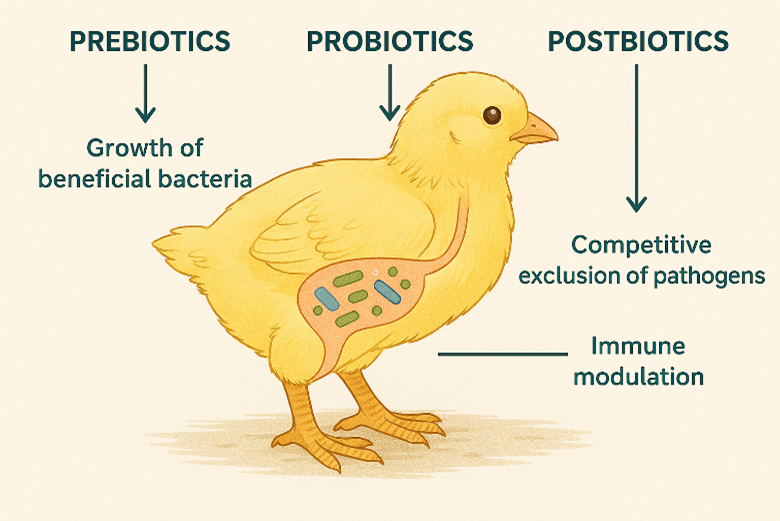


Tabulated summary of Pre- Pro- and Postbiotics:

Feature Prebiotics Probiotics Postbiotics
Definition Non-digestible ingredients that feed beneficial gut bacteria Live beneficial microorganisms Non-living microbial metabolites
Mode of Action Stimulate native beneficial microbes Introduce new beneficial microbes Deliver bioactive compounds
Stability Highly stable Sensitive to heat and moisture Very stable
Examples MOS, FOS, Inulin Lactobacillus, Bacillus subtilis SCFAs, bacteriocins, enzymes
Benefits Gut health, nutrient absorption, immune support Pathogen exclusion, immune modulation Antimicrobial, anti-inflammatory, feed efficiency

Consistency is KEY with layer-hens

by Herman Rossouw

Layer hens are quick to pick up on changes in their environment. These changes could have a negative impact on their performance and should thus be kept to a minimum. Consistency is key to achieving and maintaining optimal layer hen performance.

One of the biggest factors influencing layer hen performance is their feed. Achieving a sufficient feed intake per hen per day ensures that the hen receives all the nutrients needed for maintenance of her body’s natural processes as well as to produce eggs. It has been well documented that layer hens can sense changes in their feed -particle size, -ingredients and even energy and protein levels.

Layer hens get used to a certain feed particle size and changing this (from coarse to fine or from fine to coarse) can cause the hens to decrease their feed intake while they are adapting to the new particle size. This decreased feed intake could lead to bodyweight loss which in turn will lead to egg weight loss and production loss. Consistency in feed particle size is thus key to maintaining a good feed intake in the layer house which will maintain production.

Too coarse a feed will encourage the hens to selectively feed which means they will consume the coarse maize and calcium grit particles first and leave the finer particles like soybean meal, sunflower oilcake, vitamins and minerals. Too fine a feed will decrease feed intake as the hens need to spend more time at the feeder trough to consume the same amount of feed and often the competition at the feeder is high between hens which means feeding time is limited.

Some raw materials, for example sunflower oil cake, could also cause hens to decrease their feed intake if the percentage of inclusion of the raw material suddenly changes. This will again lead to an adaptation period where feed intake is lower than usual, and the hen will thus lose bodyweight and egg weight, and production percentage will decrease.

It is difficult for the farmer to control the consistency of the feed particle size or even the raw materials used in the feed, but the risk can be greatly mitigated by not switching between different feed suppliers too often. Building a relationship with your feed supplier will ensure consistency in the feed used on farm.

The farmer however can control or at least try and control the temperature, lighting schedule, water -availability and -quality. Large fluctuations in temperature can cause hens to be uncomfortable and thus influence their feed intake which in turn will again influence production percentage. Optimal temperatures of between 20 and 25 degrees Celsius should be the target, but in South Africa where the summers are very hot, a maximum of 27.5 degrees Celsius is still acceptable. It is important to note that humidity higher than 60% actually increases the “real-feel” temperature. The rule of thumb is that every 5 % above the 60% humidity level, increases the temperature with 1 degree Celsius and we should thus not only try and mitigate heat, but also try and keep humidity in a constant range.

Layer hen water intake is double that of their feed intake and a restriction in good, clean water will cause a decrease in feed intake. Consistent good, clean water supply with a pH of 5-6 is optimal. Always test water supply at the last nipple in the house and measure the amount of water that flows from that nipple in 60 seconds, a good rule of thumb is 60ml in 60 seconds.

As with people, layer hens do not like change, and their reaction to it can differ between different situations. Keeping variation to a minimum would decrease stress on the hen which improves her health and improves her performance.

Consistency in feed, environment and water will directly equate into consistency in production.

Heat Stress in Poultry: Physiological Impacts and Nutritional Mitigation Strategies

Introduction

Poultry are homeothermic animals with a normal body temperature range of 41–42°C. Under optimal thermal conditions, typically defined as the thermal neutral zone (18–22°C), birds can maintain their core temperature without expending additional energy. However, deviations from this range, particularly during brooding when higher ambient temperatures are necessary, impose significant physiological and behavioural adjustments. Environmental temperatures exceeding 25°C are sufficient to induce heat stress in poultry, which has profound effects on health, performance, and welfare.

Indicators of Heat Stress in Poultry

Behavioural Adaptations:
Poultry exposed to elevated temperatures exhibit distinct behavioural changes, including:

  • Reduced feed intake
  • Increased water consumption
  • Panting
  • Decreased mobility
  • Elevation of wings to expose less-feathered areas for heat dissipation

Physiological Responses:
Heat stress triggers several physiological disruptions, including:

  • Oxidative Stress: Resulting in impaired gut funtion, increased susceptibility to disease, and reduced growth rates.
  • Disturbance of Acid-Base Balance: Characterized by respiratory alkalosis and metabolic acidosis, negatively impacting production performance.
  • Immunosuppression: Evidenced by reduced antibody production and lowered white blood cell counts.

These alterations collectively compromise gastrointestinal functionality, reduce nutrient absorption, and increase intestinal permeability. Dysbiosis, characterized by a decline in beneficial microbiota and a concurrent rise in pathogenic populations, can lead to necrotic enteritis.

Neuroendocrine Changes:
Heat stress activates neuroendocrine pathways that elevate blood glucose levels and respiratory rates. These adaptations, while aimed at coping with hyperthermia, reduce growth efficiency and reproductive performance.

Nutritional Strategies for Mitigating Heat Stress

To counteract the adverse effects of heat stress, several dietary modifications can be employed:

  1. High-Energy Diets:
    Incorporating fats, which generate less metabolic heat compared to proteins and carbohydrates, enhances energy availability without exacerbating heat production.
  2. Pelletized Feed:
    Feeding pelletized diets can improve feed intake and nutrient utilization under heat stress conditions.
  3. Gut Health Enhancement:
    Indirect nutritional strategies, such as the inclusion of prebiotics, probiotics, organic acids, exogenous enzymes, and essential oils (e.g., oregano and thyme), can bolster gut integrity and mitigate the deleterious effects of heat stress.
  4. Supplementation of Vitamins, Minerals, and Phytochemicals:
    Specific nutrients with antioxidant and immune-supportive properties have proven effective:
Supplement Beneficial effect of heat stressed birds: Recommended dosage
Vitamin E Antioxidant; enhances lymphocyte proliferation 100-250mg/kg
Vitamin A Antioxidant and improves immunity
Vitamin C Reduces oxidative damage and boosts immunity 200-250mg/kg
Zinc Is associated with the antioxidant defense system, immune function, and skeletal development 40-60mg/kg organic Zn


Selenium Vital component of proteins which are different parts of enzymes in physiological processes. 0.15 – 0.3mg/kg
Electrolytes Higher range of dietary electrolyte balance (DEB): 200-300mEq/kg (use of Sodium Bicarbonate and Potassium Chloride)
Phytochemicals · Lycopene (found in tomatoes)

· Resveratrol (found in grapes, berries)

· EGCG (green tea extract)

· Curcumin (extracted from turmeric)

· Other with antioxidant properties:  Thymol, Carvacrol, Cinnamaldehyde, Silybinin and Quercetin.

·      Lycopene 200-400mg/kg

·      Resveratrol (300-500mg/kg)

·      EGCG 300-600mg/kg)

·      Curcumin 100-150mg/kg

Osmolytes · Betaine (increase water-holding capacity of the cells, thus preventing dehydration)

· Taurine (antioxidant action)

Betaine: 0.05-0.2%


Taurine: 5g/kg feed


Conclusion

Through targeted dietary interventions, poultry producers can alleviate the detrimental effects of heat stress, safeguarding poultry health, welfare, and productivity. The adoption of these strategies provides a holistic approach to enhancing thermotolerance and maintaining performance under challenging environmental conditions.

Reference

Wasti, S., Sah, N., & Misha, B. (2020). Impact of Heat Stress on Poultry Health and Performances, and Potential Mitigation Strategies. Animals, 10(1266).


Importance of feed intake in commercial layer systems

 By Herman Rossouw, technical advisor,  AFGRI Animal Feeds

The feed component of the average poultry production system makes up 70% of all expenses. Given the sharp increase in feed prices these past three years, there is renewed focus on the consumption and effectiveness of rations. In March this year, the average layer meal was 80% more expensive than in the corresponding month in 2020. In comparison, the price paid to producers for a dozen eggs rose by only around 30% in the same period. But what does optimal daily feed intake per hen in commercial egg production systems look like? The answer is somewhat complex.

Factors affecting feed intake
Excessive feed intake leads to financial losses because it adds to the feed bill and leads to health problems such as fatty liver; if the hen ingests too little feed, she will not be ingesting the nutrients she needs for optimal production and health.

A multitude of factors affect feed intake. These include temperature, humidity, water intake, housing density (competition for feeding space), diseases, stress, feed particle size, energy density of the feed, age and weight of the hen, as well as breed.

Each feed company has its own range of layer rations that differ in terms of nutrient density and energy composition – in other words, the optimal daily feed intake per hen will vary. Communication between the feed company and the producer regarding the theoretical and actual intake of a ration is therefore key.

Temperature and particle size
Hens tend to ingest less feed in the warm summer months, making it difficult to keep the actual intake in line with the theoretical intake. A more nutrient-dense feed will help to support hen production and bodyweight maintenance in summer. In this regard, management practices such as midnight feeding may assist in stimulating intake. Moreover, there are a number of supplements on the market that may help to alleviate heat stress.

Feed particle size – and more specifically changes in particle size – can quickly suppress or overstimulate hens’ feed intake. Not only will hens consume less feed if it is too fine, but such feed may also create dust in houses and lead to respiratory infections in hens and workers. Coarse particles, on the other hand, will stimulate feed ingestion, leading to selective feeding habits with hens selecting to eat the coarse particles (usually maize) first, leaving the finer particles (vitamins, minerals, enzymes and the like) behind.

With the latter in mind, it is important in especially older production systems, which still make use of manual feeding, that the hens clean out the feeders before new feed is added. To accomplish this, more daily feedings can be allowed rather than filling up the feeders in the mornings only.

Feed according to age
Although hens’ ration intake can be controlled to some extent, their physiology must be kept in mind. Young point-of-lay hens will not consume the same amount of feed than 60-week-old hens. Hence, rations and management practices need to be adjusted accordingly.

AFGRI’s Optilay Peak ration is specifically formulated for young point-of-lay hens that are physiologically unable to achieve intakes of 110 to 120g/hen/day. Once hens reach a physiological age at which they can comfortably ingest 110g/hen/day, the ration can be switched to Optilay 20.

‘To measure is to know’ is one of my favourite sayings and is very apt when it comes to feed levels and ultimately feed intakes. Daily feed intake per hen per day is the best way to identify problems early on, either with regard to the feed, hens or management practices.