
Focus on Nutrition and Stage of Pregnancy: The Key to Success
By Leon Botha, Technical Advisor at AFGRI Animal Feeds
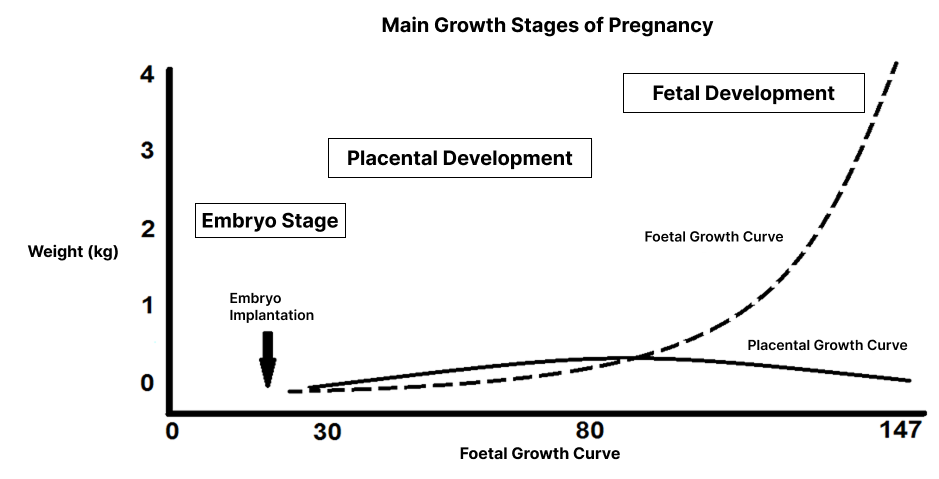
Focused nutrition during pregnancy can have a positive impact on the reproduction, production, and profitability of a sheep flock. It is important to know which stage of pregnancy (early, mid, or late) the ewe is in so that nutrition can be provided to meet the specific development and growth requirements of that stage. During pregnancy, growth patterns vary between embryo implantation, placental growth, and fetal growth.
The early stage of pregnancy is critical for embryo implantation and placental development. Ewes on a low nutritional plane that are unable to at least maintain their body weight are at risk of embryonic loss and poor placental development. Placental growth should be supported from this stage through to mid-pregnancy, as optimal placental development offers numerous benefits for reproduction, birth weight, lamb survival, and weaning percentages.
Figure 1: The Main Growth Stages of Pregnancy
(Source: ResearchGate)
Optimal Placental Development
Placental development occurs mainly between days 30 and 80 of pregnancy, after which it supports the exponential growth of the fetus during late pregnancy. Placental size therefore has a direct influence on the lamb’s birth weight. Lambs with low birth weights experience higher mortality rates, which can be prevented through optimal placental development.
The placenta also influences the ewe’s milk production potential, as it releases a hormone called placental lactogen, which stimulates mammary gland development. Mammary gland development takes place from approximately day 100 of pregnancy until lambing and ultimately determines the ewe’s milk production potential and udder size. This has a significant effect on lamb survival and weaning weights.
It is also important to note that placental growth can only be influenced by nutrition during mid-pregnancy and cannot be corrected during late pregnancy (after day 80).
Condition of Late-Pregnant Ewes
In late-pregnant ewes, nutrition is of critical importance from day 100 until lambing, as fetal growth rates are extremely high during this period. Undernutrition at this stage can result in lower birth weights. Careful attention should be paid to the energy and protein composition of supplements during this phase to support optimal fetal growth.
The body condition of late-pregnant ewes should also be maintained at a high level, as ewes in good condition generally produce heavier lambs.
Ewes carrying multiple fetuses have significantly higher energy requirements than ewes carrying single lambs and should be fed according to these differing needs. The use of a more concentrated supplement can help meet nutritional requirements, as the enlarged uterus reduces feed intake due to physical limitations on rumen capacity.
Colostrum and Milk Production
Poor nutrition during the final month of pregnancy can negatively affect both milk production and the quantity and quality of colostrum, leading to higher lamb mortality and lower weaning weights. Correct vitamin and trace mineral levels during the last month of pregnancy are also essential for milk and colostrum production.
Particular attention should be paid to vitamin E and selenium levels in the ration, as both have a positive effect on milk production and colostrum quality. A large supply of high-quality colostrum can also be ensured by providing adequate levels of bypass protein in the diet. Bypass proteins also play a major role in udder development during the final week of pregnancy.
Conclusion
Focused nutrition during each stage of pregnancy can provide significant economic benefits and improved profitability for the flock. By understanding which nutritional requirements need to be met and how these requirements change throughout pregnancy, producers can cost-effectively ensure healthy, viable lambs and improved flock profitability.
Graph adapted from: Fetal Mechanisms That Lead to Later Hypertension – Scientific Figure on ResearchGate. Available at: https://www.researchgate.net/figure/Fig-4-Feto-placental-growth-curves-in-the-sheep_fig4_6147512 (accessed 9 May 2019).
.png)

