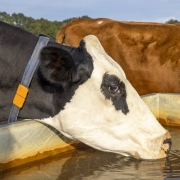
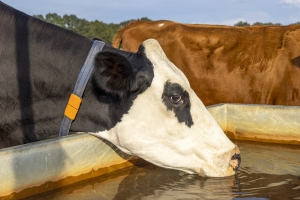
Waterkrip bestuur

Dries Swart, AFGRI Veevoere

Water is vir alle diere noodsaaklik vir lewe en is die een nutriënt wat in die grootste hoeveelhede benodig word deur soogdiere. Water speel ‘n baie belangrike rol in melkproduksie, beheer van liggaamstemperatuur en baie ander liggaamfunksies in melkbeeste. Alhoewel voer en rantsoen beheer gereeld in diepte bespreek word, word waterinname, beskikbaarheid en kwaliteit gereeld misgekyk.

‘n Beperking in toegang tot skoon, vars en hoë kwaliteit water kan baie vinniger ‘n negatiewe uitwerking op melkproduksie hê as ‘n tekort aan enige ander nutriënt, aangesien melk uit ongeveer 87% water bestaan. Behalwe dat water so ‘n groot persentasie van melk opmaak, reguleer dit ook voerinname. Daarom is dit van kardinale belang om te verstaan hoe belangrik water vir diere is, asook hoe om dit reg te bestuur in ‘n melkery om seker te maak dat die diere genoeg water sal inneem.

Koeie in melk benodig ongeveer 5L water vir elke 1kg melk wat geproduseer word, waarvan 80% tot 90% afkomstig is van drinkwater, die res word vanuit die voer opgeneem.

Temperatuur en humiditeit verhoog drasties die hoeveelheid water wat benodig word, veral tydens warm somerdae, wanneer diere hittestres ervaar. Waterinname kan dan met ‘n faktor van 1.2 tot 2 maal die normale behoefte verhoog word. Dus kan ‘n koei wat 50kg melk produseer tussen 250 en 350 liter water per dag drink wanneer temperature 27®C bereik. Om die koeie toe te laat om hierdie groot hoeveelhede water in te neem, kan dit nodig wees om ekstra water punte beskikbaar te maak wanneer die temperatuur styg.

Die water moet ook baie goeie kwaliteit wees om te verseker dat die koeie voldoende hoeveelhede sal inneem.  Onvoldoende water toevoer, of water van ‘n swak gehalte kan lei tot ‘n verlies in produksie, verlaag algehele weerstand tot siektes en kan in sommige gevalle lei tot ‘n uitbraak van siektes.  Water krippe moet dus teen minste een maal per week dreineer en skoongemaak (geskrop) word met ‘n swak chloor oplossing (1 koppie huishoudelike ‘bleach’ opgelos in 20L water) om water kwaliteit te verbeter. Die oplossing moet uitgespoel word en met skoon water vervang word na die skoonmaak proses.

In die algemeen drink koeie in kort intervalley (7-12 maal per dag) waartydens hulle tussen 10 en 20 liter water op ‘n slag sal drink, daarom is die vloei tempo van die water by die krippe baie belangrik om voldoende waterinname toe te laat. Koeie moet in staat wees om water te drink sonder om lug te sluk. Wanneer koeie direk uit die waterkrip se kraan drink moet daar inspeksie op die vloeitempo gedoen word om te verseker dat dit voldoende is.

In terme van water beskikbaarheid moet daar minstens twee water punte beskikbaar wees per groep, om te voorkom dat dominante beeste ‘n enkele water punt kan beheer en sodoende die ‘swakker’ diere verhoed om genoeg water in te neem. Daar moet voorsiening gemaak word sodat 10% tot 15% van ‘n kudde gelyktydig kan drink. ‘n Minimum van 1.2m trog spasie moet beskikbaar wees vir elke 20 koeie (oop-oppervlak watertenk) om dit moontlik te maak.

Waterpunte moet geplaas word in areas wat direk na melking beskikbaar is. Die waterpunte moet groot genoeg wees om al die koeie wat terug keer vanaf ‘n melking gelyktydig te akkommodeer. Melkkoeie drink 50 – 60% van hul daaglikse water behoefte direk na melking. Daarom word dit aanbeveel om ongeveer 0.5m krip spasie per koei beskikbaar te maak in die wandelpad vir die koeie wat na melking terug na hul behuising of kraal stap.
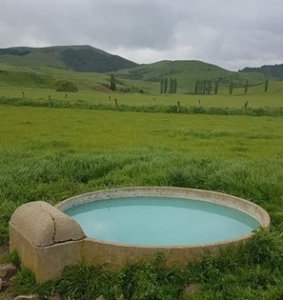
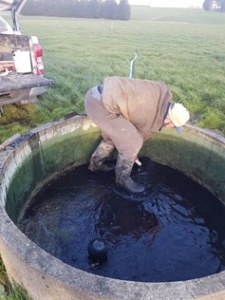
 

Skoon waterkrip.                   Skoonmaak (skrop) van vuil krip.


Complementing your Spring pasture for maximum and sustained production

by Tian Keet, Technical Advisor, AFGRI Animal Feeds.


Spring is an exciting time in the dairy industry especially for the farmer milking off pasture-based systems. This is your time for more profitable milking due to generally lower input costs and expected higher milk production. Spring however, seem to past far quicker than what we want, thus you need to get the most out of it while it lasts. To achieve this, you need to complement your pasture to get maximum milk production out of it and sustain that level of production for as long as possible. With issues related to our current economy, high costs of land and increasing production costs, pasture-based systems will require higher per animal production.

What does your pasture supply?

Crude Protein (CP) of pastures grazed in Spring typically range from 23 – 30 percent. This mainly consists of highly degradable protein which gets broken down in the rumen to ammonia.  The recommended dairy CP requirements for a lactating dairy cow range from 15 percent. With the high CP content of Spring pasture, you will easily exceed the CP requirements with a typical ration consisting of 70% pasture. Furthermore, the ammonia produced through pasture protein degradation in the rumen, will far outweigh that what can be used by the rumen microbes.

Neutral detergent fibre (NDF), primarily obtained from roughages, is extremely important in all ruminant diets.  Dairy cows, as in all ruminants, require enough fibre for optimal rumen function and to stimulate rumination. Through rumination cows mechanically break down fibre further and produce saliva which buffers the rumen. Fibre also forms a rumen mat and slows down the rate of passage which facilitate rumen microbes to break down fibre more efficiently. Neutral Detergent Fibre (NDF) typically range from 40 – 50 percent in pasture, thus can easily meet the dietary requirements of 28 – 35 percent NDF for lactating dairy cows. However, newly planted Spring ryegrass may have levels below 40 percent NDF at the first grazing.

What does your pasture need?

Energy is the first limiting nutrient for high producing cows grazing high quality pastures as the only feed (Kolver and Muller, 1998). Cows on pasture-based systems are often expected to walk great distances to paddocks to graze. Furthermore, dry matter intake (DMI) are significantly less for cows on pasture compared to cows on total mixed rations (TMR). Thus, losing a lot of energy through higher activity but also not getting enough energy in, due to lower DMI. Our African climate with higher temperatures adds to the issue. Cows willingly eat less in times of heat stress in an attempt to reduce metabolic heat. In addition, cows under heat stress have a higher energy cost to maintain body temperature.

It is essential to supply a good, well-balanced premix consisting of minerals and vitamins to meet the requirements of high producing cows. Soil profiles in and between farms vary significantly in mineral composition, hence the importance of a premix to supply the shortfalls. Certain vitamins (A, D and E) are recommended to be supplemented to cows housed in confinement. Cows on pasture, on the other hand, don’t need supplementary vitamin D as it is synthesized in the presence of sunlight.

Young Spring pasture, in difference to more mature pasture, have lower NDF. This causes a quicker rate of passage and sub-optimal rumen mat formation. By supplying a small amount of good quality hay or maize silage (1 – 2 kg DM) will stabilise rumen conditions and slow down the rate of passage.


Benefits of complementing your pasture with the right concentrate

Higher milk production can be expected with supplementing concentrate. Supplementary concentrate will supply the energy that falls short on pasture-based systems and allows cows to reach their genetic potential. It is important to supply highly available energy. Rumen microbes need energy to grow. With enough available energy, rumen microbes will grow and function more efficiently. Fresh in milk cows are in a negative energy balance, concentrate feeding can help them get out of that negative energy balance far quicker. Furthermore, cows will hold body condition better or recover body condition sooner.

Rumen ammonia will reduce with concentrate feeding. The rumen microbes now have the needed energy to utilise this free-flowing ammonia and convert it into microbial protein. Excess rumen ammonia is converted to urea in the liver which is an energy costly process. In utilizing rumen ammonia more efficiently, the cow conserve energy. Studies have shown that supplementing concentrate to cows on pasture, increase milk protein (Petch et al., 1997; Sayers, 1999; Reis and Combs, 2000).

To summarise

Milking off pasture-based systems are most profitable when pastures are utilised to the fullest. In this, you only need to supply where pasture falls short and not replace what it already supplies. Hence complimenting your pasture. By doing so you will meet all the requirements of a high producing dairy cow, milk those cows to their genetic potential and sustain milk production for longer.


Calf & Heifer Rearing – “Accelerated Growth”

by Jacques Potgieter


Efficient milk production is the key focus of any dairy operation. To ensure our aim of efficient milk production it is essential that calves and heifers are grown out properly and timeously. As the profitability of the dairy industry becomes more under pressure and dairy farms increases in size, the economics of calf and heifer rearing systems has become a vital aspect of the farms profitability. Accelerated growth can be used in the context where specific management goals are met within a specific timeframe. Production goals such as the target weight and age at which a group of heifers is to be confirmed pregnant will indicate the age at first calving. There are many factors such as the quantity and quality of colostrum and milk fed to the calves together with the quality of the starter (E.g. the type of protein in the starter) which all will affect the end goal.

The first day, especially the first few hours of a calf’s life are critical to its health and survival. Failure of passive transfer of antibodies will have a delayed effect on time to first calving, lower average daily gain (ADG) up to 6 months and will impact milk production as well as the quality of milk negatively during the first lactation.

High quality colostrum will have a specific gravity value of > 50mg/ml IgG or Brix value of at least 22% (Colostrometer). Ideally, the first feeding of colostrum must be fed to calves within 30min after calving and the second feeding within 6 hours after the first feeding. Calves should be fed 10% of bodyweight (4L) at first feeding and 5% of bodyweight (2L) at second feeding. Research indicated that a calf fed colostrum for the first 4 days will be more efficient, growing faster and potentially producing more milk per lactation over her lifetime.

Traditionally, calves have been fed limited amounts of milk or milk replacer to stimulate early intake of starter and to minimize input costs (conventional system). Some of the disadvantages of the conventional milk feeding systems are decreased efficiency of body size gain, increased time to breeding and first calving, decreased ability to withstand infectious challenges and lower milk production during the first and second lactation.

Accelerated calf growth programs (intensified early nutrition programs) involve feeding calves higher amounts of milk during the first 60 days compared to the conventional 4L per day (Holstein calves) and 3L per day (Jersey calves) in combination with a high-quality starter. Milk feeding rates are approximately twice those of conventional systems. If a milk replacer is being used it is important to take note of the protein quality (Whey and Skim Milk powder), without plant-based proteins, Ash is less than 10% of dry matter, Fibre less than 0.15% and avoid high amounts of free fatty acids and polyunsaturated vegetable oils.

Epigenetics play a major role during the pre-weaning period. Research indicates that for every gram a calve grows above 450 grams per day from birth up till weaning will result to a minimum of 1L/gram above 450 grams growth per day, additional milk in the first lactation. E.g., if a calve has an average daily gain of 1kg/day in the pre-weaning period she is most likely to produce 550 Liters more in her first lactation. Calves should at least double their birth weight and consume a minimum of 1kg starter for three consecutive days at weaning.

Access to ad libitum fresh water is crucial from day one as it encourages early consumption of the calf starter and stimulates higher total feed intake.

Heifers should weigh 55% of the average mature weight of the milking herd (4th plus lactation) at breeding. Body weight and sexual maturity should be the determining factor for breeding and not age. The benchmark for the weight of a heifer at first calving should be 85% and 92% at second lactation of mature body weight.


Conclusion:

The concept of accelerated feeding for young milk-fed calves is now well-accepted as an alternative to traditional restricted feeding. The correct accelerated growth program will result in a calf that will grow faster, reach her age at first calving sooner (< 24 months) and will have increased milk production. We cannot change the genetic merit of our heifers, but we must assure that her full genetic potential can be reached as a lactating cow.